



In brief
Spiro's $215 million raise signals that electric mobility in Africa is ready for prime time. Battery swapping, EV financing and the software opportunities behind the hardware.
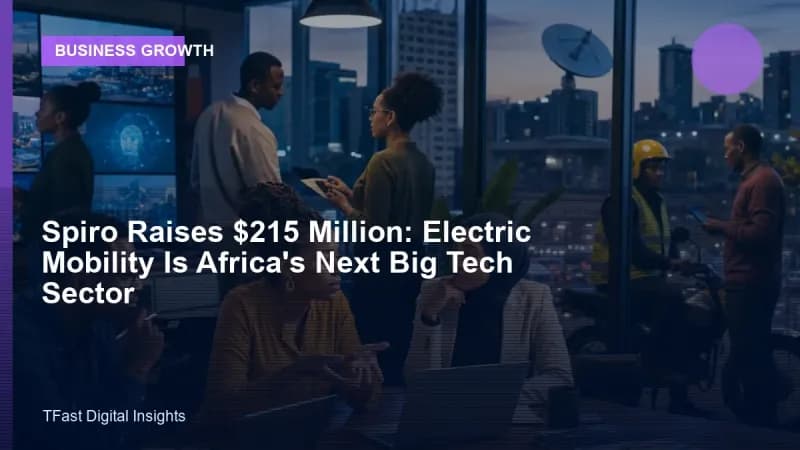
Spiro, the pan-African electric mobility company, just closed a $215 million funding round, one of the largest ever in African climate tech. Combined with Uganda's Gogo Electric also receiving funding, the signal is clear: electric mobility in Africa is no longer a pilot project. It is an industry.
Why Spiro matters
Spiro builds and deploys electric motorcycles and battery-swapping stations across Benin, Togo, Rwanda, Uganda, Kenya and Nigeria. Its model:
- Riders lease or finance electric motorcycles instead of buying petrol ones.
- When the battery runs low, riders swap it at a Spiro station in under two minutes, no waiting for a charge.
- The battery-as-a-service model means riders pay for energy, not the battery, reducing upfront costs.
This is smart for Africa, where motorcycles ("boda bodas") are a primary mode of transport and a major source of employment. Electric bikes are cheaper to run than petrol bikes, lower fuel costs, less maintenance. The challenge has always been the upfront cost and charging infrastructure. Spiro's battery-swapping model solves both.
The software opportunity behind the hardware
Every Spiro bike, every swap station and every rider generates data. That data needs software to manage it:
- Fleet management: tracking thousands of bikes across six countries. Where is each bike? Is it due for maintenance? Is the battery performing as expected?
- Battery analytics: predicting battery degradation, optimising swap station inventory, routing bikes to stations with available charged batteries.
- Payment and financing: riders making daily or weekly payments. Integration with mobile money. Credit scoring based on riding and payment history.
- Customer apps: riders need to find swap stations, check battery availability, make payments and contact support.
- Operations dashboards: for Spiro's operations team to monitor the entire network in real-time.
This is exactly the kind of software TFast Digital Agency builds: custom business systems, mobile apps, payment integration and data dashboards.
Gogo Electric and Uganda's e-mobility scene
Uganda's own Gogo Electric recently received funding to expand its operations. Kampala's boda boda industry, tens of thousands of riders, represents both a massive pollution problem and a massive electrification opportunity. Companies like Gogo, Zembo and Spiro are racing to capture this market.
The bigger picture: Africa's battery industry
Afreximbank's $125 million investment in Spiro is part of a larger strategy: building Africa's battery value chain. Africa has an estimated 26.7 million tonnes of lithium resources. Zimbabwe, DRC, Mali, Nigeria, Namibia and Ghana all have significant deposits. But historically, Africa has exported raw lithium and imported finished batteries. That model is changing.
Morocco is building Africa's largest lithium-ion battery gigafactory ($1.3 billion investment by Gotion High-Tech). Zambia and DRC are developing a $2.7 billion battery special economic zone. The vision: mine lithium in Africa, process it in Africa, manufacture batteries in Africa, power African electric vehicles.
What this means for tech businesses
The e-mobility and battery sectors need software, lots of it. Fleet management, payment processing, supply chain tracking, carbon credit verification, customer apps. If you are a software developer, mobile app builder or systems integrator, the e-mobility sector is hiring, literally and figuratively.
TFast Digital Agency is ready to build the software layer that powers Africa's electric mobility revolution. Contact us if you are in this space and need a technology partner.
<!-- SEO keyword optimization: spiro electric mobility africa 2026 -->Focusing on spiro electric mobility africa 2026 is essential for modern business success.