


In brief
Modern software architecture in 2026, from AI-native design patterns and edge computing to WebAssembly, microservices evolution and the rise of local-first apps.
Software architecture in 2026 is being reshaped by three forces: AI moving from cloud to device, the maturing of WebAssembly, and the pendulum swinging back from microservices towards pragmatic modular monoliths. Here is what architects and senior developers need to know.
1. AI-native architecture (not AI as an afterthought)
The biggest architectural shift of 2026: designing applications where AI is a first-class architectural component, not a feature tacked onto an existing system.
Pattern: AI orchestrator + domain services
An AI orchestrator receives user intent (natural language, voice, gesture), reasons about it, and coordinates domain services to fulfil it. The user does not navigate menus. They express intent, and the system figures out the rest.
User: "Show me last month's sales compared to the same month last year, and flag products with declining margins."
→ AI Orchestrator interprets intent
→ Calls Analytics Service for sales data
→ Calls Reporting Service for margin calculations
→ AI generates narrative insights
→ Returns visualisation + written analysis
Pattern: On-device inference pipeline
For privacy, cost and offline capability, run AI models locally. Android 17's AI Core, Apple's Core ML and WebGPU in the browser all enable this. Data never leaves the device.
Pattern: AI-in-the-loop workflows
Human reviews AI output before it is finalised. AI drafts the marketing email; human approves. AI suggests the inventory reorder; human confirms. This balances AI efficiency with human judgment.
2. The modular monolith renaissance
After a decade of "microservices for everything," the industry is rebalancing. The modular monolith, a single deployable with well-defined internal module boundaries, is the pragmatic choice for most applications in 2026.
When to use a modular monolith: teams under 20 developers, early-stage products, applications where the domain is still being discovered, and when operational simplicity matters more than independent scaling.
When microservices still win: independent team scaling (50+ developers), independent deployment cadences, radically different scaling needs per component, and polyglot persistence (different databases for different services).
Laravel's module system and .NET's vertical slice architecture both support clean modular monoliths that can be extracted to services later if needed.
3. WebAssembly (Wasm) goes mainstream
WebAssembly is no longer experimental. In 2026, it runs in every major browser, on the server (WASI, WebAssembly System Interface) and at the edge.
What you can build with Wasm in 2026:
- Browser-side video/image editing: run FFmpeg, ImageMagick directly in the browser. No server upload needed.
- Cross-platform plugins: write a plugin once in C/Rust, compile to Wasm, run in any Wasm runtime (browser, server, edge).
- Edge compute: run custom logic on CDN edge nodes (Cloudflare Workers, Fastly Compute) at massive scale with cold starts under 1ms.
- Multi-language ecosystems: a Laravel app can run a Rust-compiled Wasm module for compute-intensive tasks without leaving the PHP ecosystem.
4. Local-first and sync engines
The local-first architecture pattern has matured. Applications use a local database (SQLite, IndexedDB) as the primary data store, with background sync to a server. The user always has their data locally, fast, offline-capable and private.
Key technologies: CRDTs (Conflict-free Replicated Data Types) for automatic conflict resolution, ElectricSQL and PowerSync for Postgres-to-SQLite sync, and Yjs and Automerge for collaborative editing.
This pattern is perfect for African markets where connectivity is inconsistent. Your app works perfectly offline, syncing when the user connects to WiFi.
5. Event-driven and async-first design
Applications are increasingly event-driven, components communicate through events and message queues rather than direct API calls. This decouples services and makes systems more resilient.
Event types in a modern architecture:
- Domain events: "OrderPlaced," "PaymentConfirmed," "ShipmentDispatched."
- Integration events: cross-service communication.
- Notification events: push to users (SMS, WhatsApp, email, push).
Laravel's event system with queue workers (Redis, SQS) handles this elegantly. See our business automation guide.
6. Security architecture: Zero trust by default
Zero trust architecture ("never trust, always verify") is now standard for new applications:
- Every service-to-service call is authenticated (mTLS or API keys).
- Every user request is authorised (not just authenticated) against the specific resource.
- Database encryption at rest and in transit.
- Secrets never in code or config files: use vaults (AWS Secrets Manager, HashiCorp Vault, Laravel's encrypted
.env). - Audit logs for every sensitive action.
See our web application security checklist for implementation details.
7. Observability: The third pillar
Monitoring (knowing something is wrong), observability (understanding why) and alerting (knowing before users tell you) are now architectural concerns, not ops afterthoughts.
The stack: OpenTelemetry for tracing, Prometheus for metrics, Grafana for dashboards, Sentry for error tracking. Structured logging (JSON) from day one.
How TFast builds
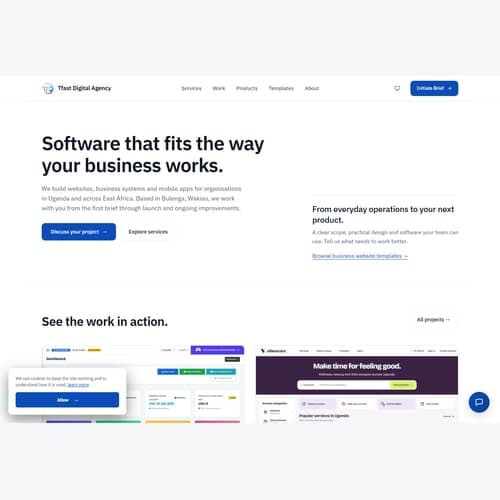
At TFast Digital Agency, we build our own website and business platforms on Laravel (PHP) with Blade templates and a MySQL/MariaDB database. The architecture for a client project depends on its requirements.
See our full stack roadmap for more details. Whether you need a custom ERP, a SACCO platform or a mobile app, we architect for security, scalability and the realities of African connectivity.
<!-- SEO keyword optimization: software architecture trends 2026 -->Focusing on software architecture trends 2026 is essential for modern business success.