

In brief
From backend to frontend, databases to deployment, the skills, frameworks and tools that matter most for web developers in 2026.

Web development in 2026 rewards developers who are T-shaped, deep expertise in one stack, with broad knowledge across the full spectrum. Here is what matters and what is just noise.
Backend: The foundation
Laravel (PHP) remains the most productive backend framework for business applications. Version 13 brings improved queue handling, better AI integration (first-class support for the Laravel AI package), enhanced Inertia.js SSR and continued security hardening. If you build business software (CRMs, ERPs, e-commerce, SaaS) Laravel is the fastest path from idea to production.
Node.js / Express / Fastify dominate when you need real-time features (WebSockets, live chat) or when your team is JavaScript-only.
Go and Rust are growing for performance-critical microservices. Not replacing PHP/Node.js, complementing them for specific high-throughput services.
Frontend: The interface
React 19 with Server Components and improved Suspense. Pair with Next.js 15 for SSR/SSG, or Inertia.js for the best Laravel + React integration. TypeScript is no longer optional. It is expected.
Vue 4 with the Composition API and Vapor mode (experimental, zero-virtual-DOM compilation). Excellent for teams that prefer convention over flexibility.
Svelte 5 with runes, a fundamentally different reactivity model that compiles to minimal JavaScript. Growing fast but smaller ecosystem.
Tailwind CSS v4, utility-first CSS, now with CSS-first configuration and improved performance. Pair with shadcn/ui for accessible, customisable components.
Databases: The storage
PostgreSQL continues gaining ground. Better JSON support, full-text search, and extensions like PostGIS make it the most versatile relational database. MySQL 9 remains solid for traditional workloads. SQLite is surprisingly capable for single-server apps and embedded use cases.
For caching and queues: Redis (or Valkey, the open-source fork). For search: Meilisearch (self-hosted, simple) or Elasticsearch (complex, powerful). For file storage: S3-compatible (AWS S3, Cloudflare R2, MinIO self-hosted).
AI integration (not optional anymore)
Every web application in 2026 should consider AI features: chatbots for customer support, content generation for marketing, intelligent search, predictive analytics. The Laravel AI package makes integrating multiple AI providers (DeepSeek, OpenAI, Gemini, Anthropic) straightforward. Start with one small AI feature and expand.
DevOps & deployment
- Docker for consistent development and production environments.
- GitHub Actions / GitLab CI for automated testing and deployment.
- Laravel Forge / Ploi for zero-downtime PHP deployments.
- Cloudflare for DNS, CDN, DDoS protection and SSL.
- Supervisor / systemd for process management (queue workers, SSR servers).
What NOT to learn in 2026
- jQuery, completely replaced by modern frameworks.
- AngularJS (1.x), end of life. If you are on it, migrate now.
- Grunt / Bower, ancient tooling. Use Vite.
- Create React App, deprecated. Use Vite or Next.js.
- Any framework without TypeScript support.
The TFast stack
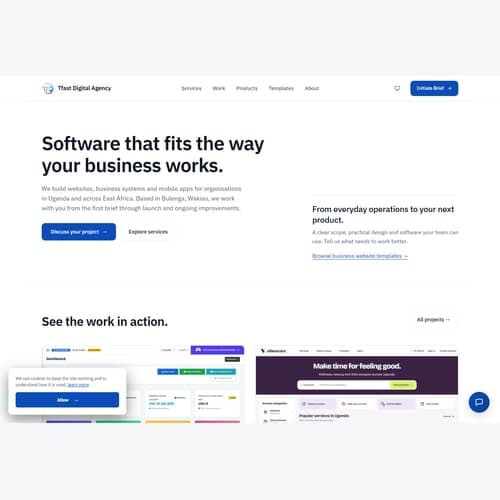
At TFast Digital Agency, our own website and business systems run on Laravel (PHP) with Blade templates and a MySQL/MariaDB database. For Windows desktop software we use C# / .NET. The right stack depends on the project.
Whether you are learning web development or hiring a team to build your platform, this roadmap reflects the technologies that deliver real business results in 2026.
<!-- SEO keyword optimization: web development roadmap 2026 -->Focusing on web development roadmap 2026 is essential for modern business success.