



In brief
Uganda granted Starlink an operating licence in May 2026. Here is what that means for rural internet, MTN and Airtel competition, business opportunities and election-period connectivity.
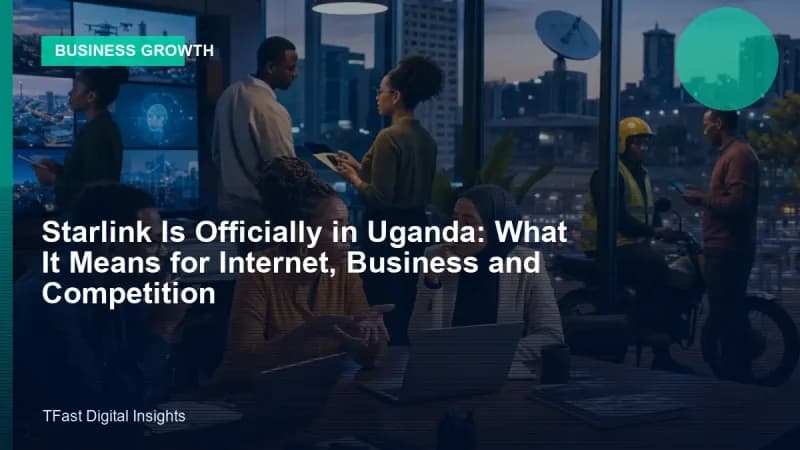
After a long regulatory standoff, Uganda finally granted SpaceX's Starlink an operating licence. The agreement was signed with the Uganda Communications Commission (UCC) at State House Entebbe on May 15, 2026. For a country where 4G coverage still sits at 82% of the population, this is not just a tech headline. It is an infrastructure pivot.
What Starlink brings to the table
Starlink is different from every internet option Ugandans have used before. It does not need fibre cables or cell towers. A small satellite dish, about the size of a laptop screen, connects directly to a constellation of low-earth-orbit satellites. That means:
- Rural areas get real broadband: villages, farms, schools and health centres that MTN and Airtel have not reached (and probably never will, on current economics) can now get high-speed internet.
- No towers required: Starlink bypasses the traditional infrastructure entirely. No fibre trenching. No tower construction. Just a dish and a clear view of the sky.
- Speeds that matter: Starlink promises 50–200 Mbps download speeds with latency around 25–50ms. That is fast enough for video calls, streaming, cloud applications and remote work, things that are painful or impossible on 3G.
Why the regulatory standoff took so long
The UCC and Ugandan government had legitimate concerns: data sovereignty (data routing through foreign servers), national security, spectrum allocation, and most sensitive of all, the economic impact on MTN Uganda and Airtel Uganda, both of which pay substantial licence fees and taxes and employ thousands of Ugandans.
Starlink's entry was never just a technical question. It was a political and economic one. The resolution suggests Uganda decided that the benefits of universal connectivity outweigh the risks of disrupting incumbent telcos.
What this means for MTN and Airtel
Let us not sugar-coat it: the telcos are worried. Starlink competes directly with their data revenue, the most profitable part of their business. Voice and SMS are declining globally; data is the growth engine. A competitor that can offer high-speed internet without building a single tower or laying a single fibre is an existential threat to the traditional telecom model.
MTN and Airtel have raised concerns about unfair competition, Starlink does not pay the same spectrum fees, does not face the same universal service obligations and does not employ thousands of local staff. These are legitimate arguments. But from a consumer perspective, competition is good. It forces incumbents to lower prices and improve service.
The business opportunities
For Ugandan businesses, Starlink opens doors that were previously closed:
- Remote work hubs: co-working spaces in rural towns connected by Starlink. A developer in Soroti can work for a company in Kampala or London.
- Agritech and IoT: farms can deploy sensors, drones and automated systems that need reliable internet. Starlink makes precision agriculture viable in locations that cellular networks ignore.
- Tourism: safari lodges, remote hotels and national parks can offer guests high-speed WiFi, transforming the guest experience.
- Education and telehealth: rural schools and clinics get access to video-based learning and remote consultations.
- Backup connectivity: even businesses in Kampala can use Starlink as a failover when fibre is cut (which happens often enough to be a business risk).
The $280 million 4G gap
A UCC-backed study found that Uganda needs approximately USD 280 million to expand 4G population coverage from 82% to 95%. That means roughly 1,250 new broadband sites. Starlink does not solve this problem. It sidesteps it. But the question remains: should Uganda invest in both satellite AND traditional infrastructure? The answer is almost certainly yes. Redundancy and diversity in connectivity are national resilience.
What TFast Digital Agency thinks
At TFast, we have been building websites, software and payment systems for Ugandan businesses for years. One of the biggest constraints has always been connectivity, clients in rural areas cannot use cloud-based systems reliably. Starlink changes that equation.
If your business is in a rural area or you have been held back by unreliable internet, now is the time to plan your digital transformation. Contact TFast to discuss how reliable internet plus custom software can transform your operations.
We also expect Starlink to accelerate interest in e-commerce, online education platforms and cloud-based business tools across Uganda. The infrastructure layer is finally arriving. The application layer, what TFast builds, is next.
<!-- SEO keyword optimization: starlink uganda licence internet -->Focusing on starlink uganda licence internet is essential for modern business success.